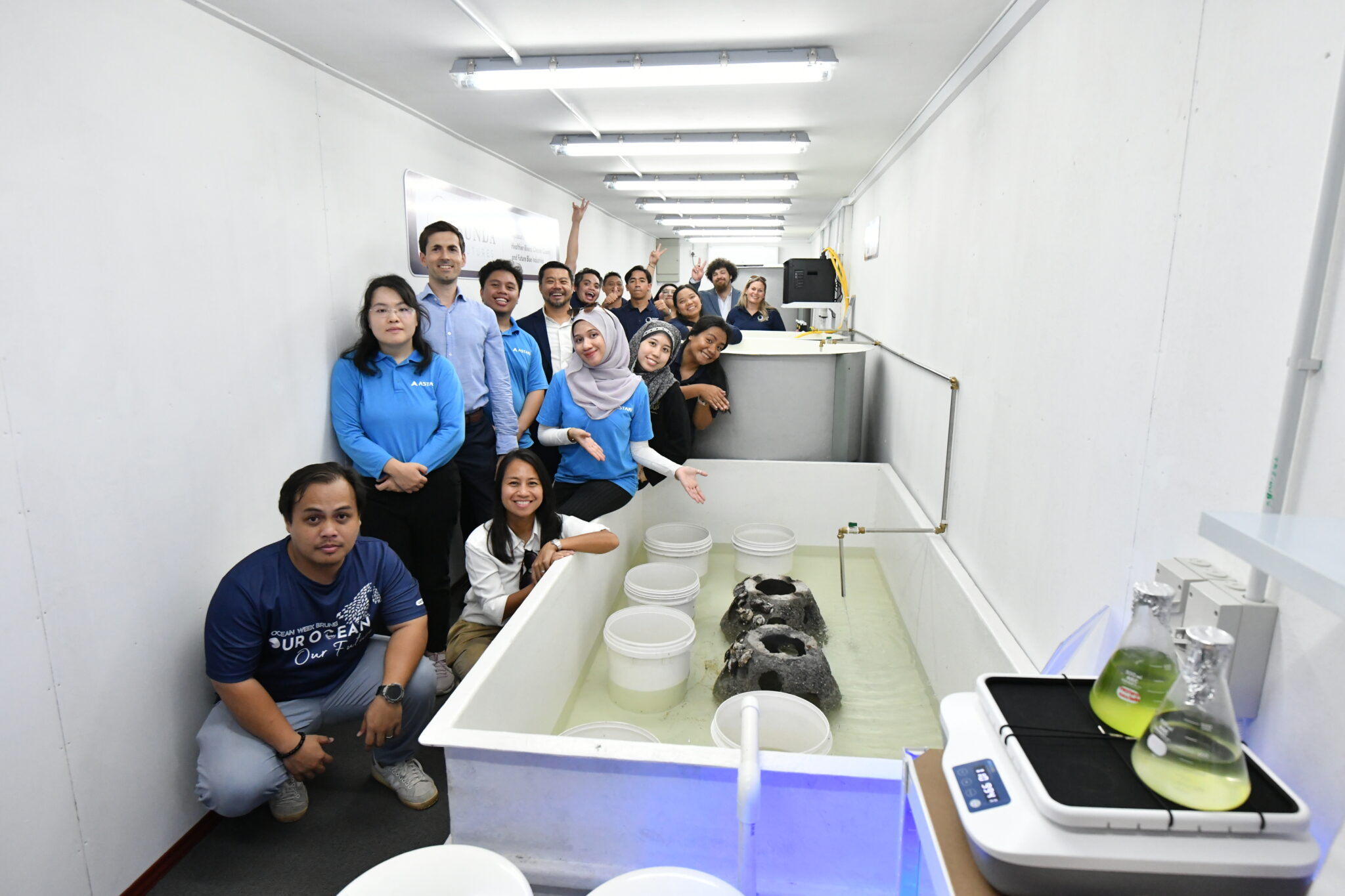
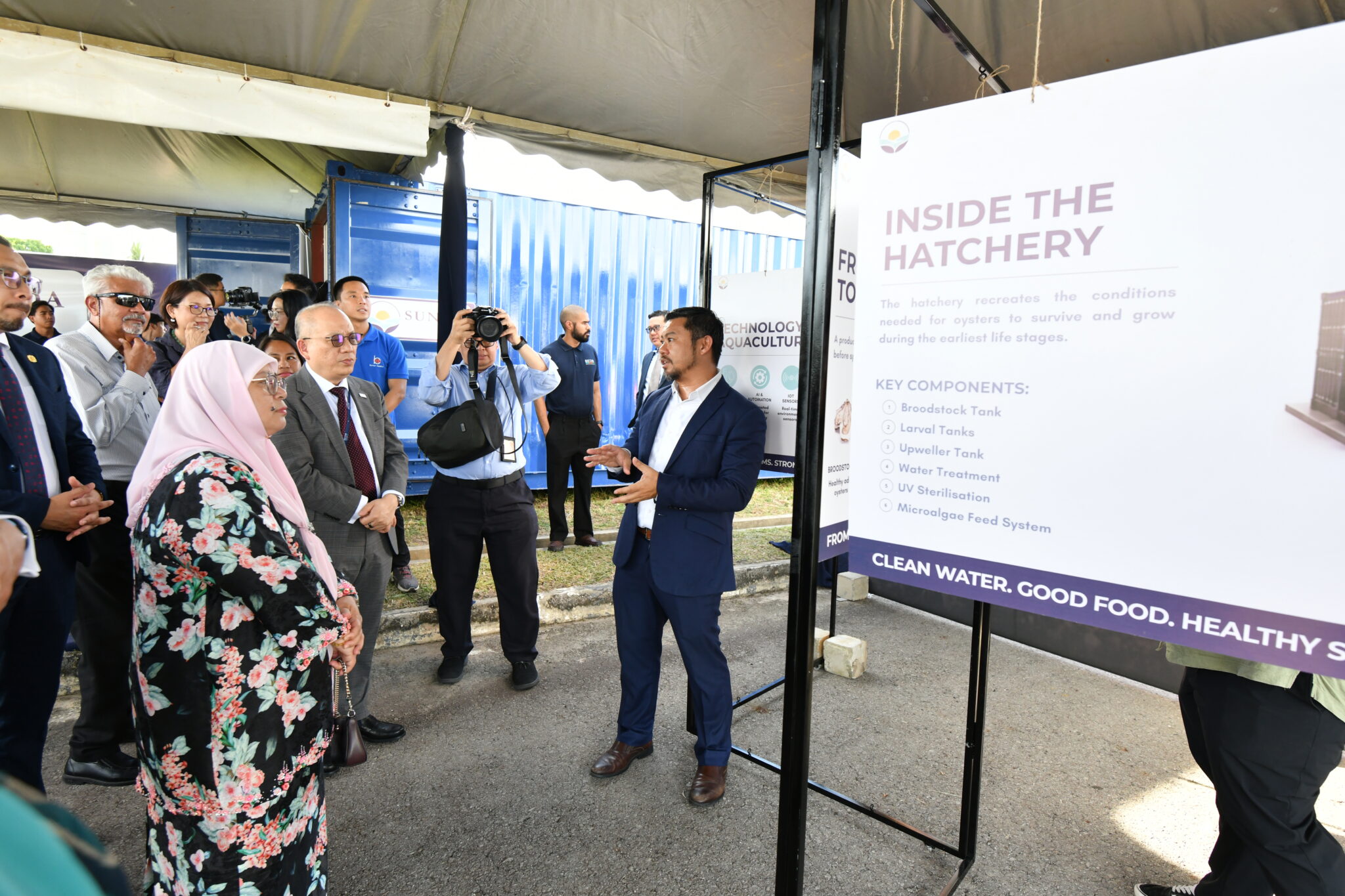
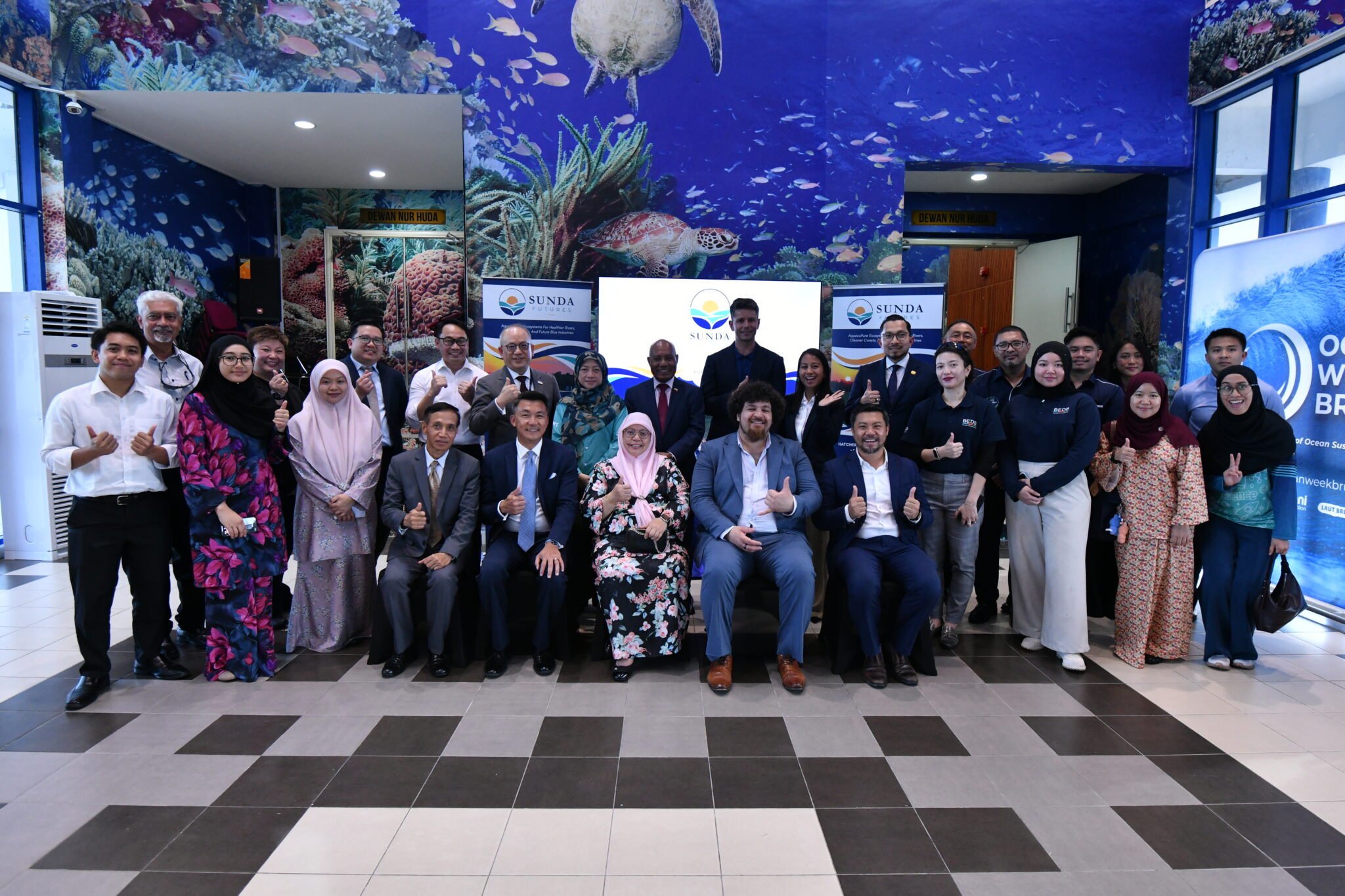
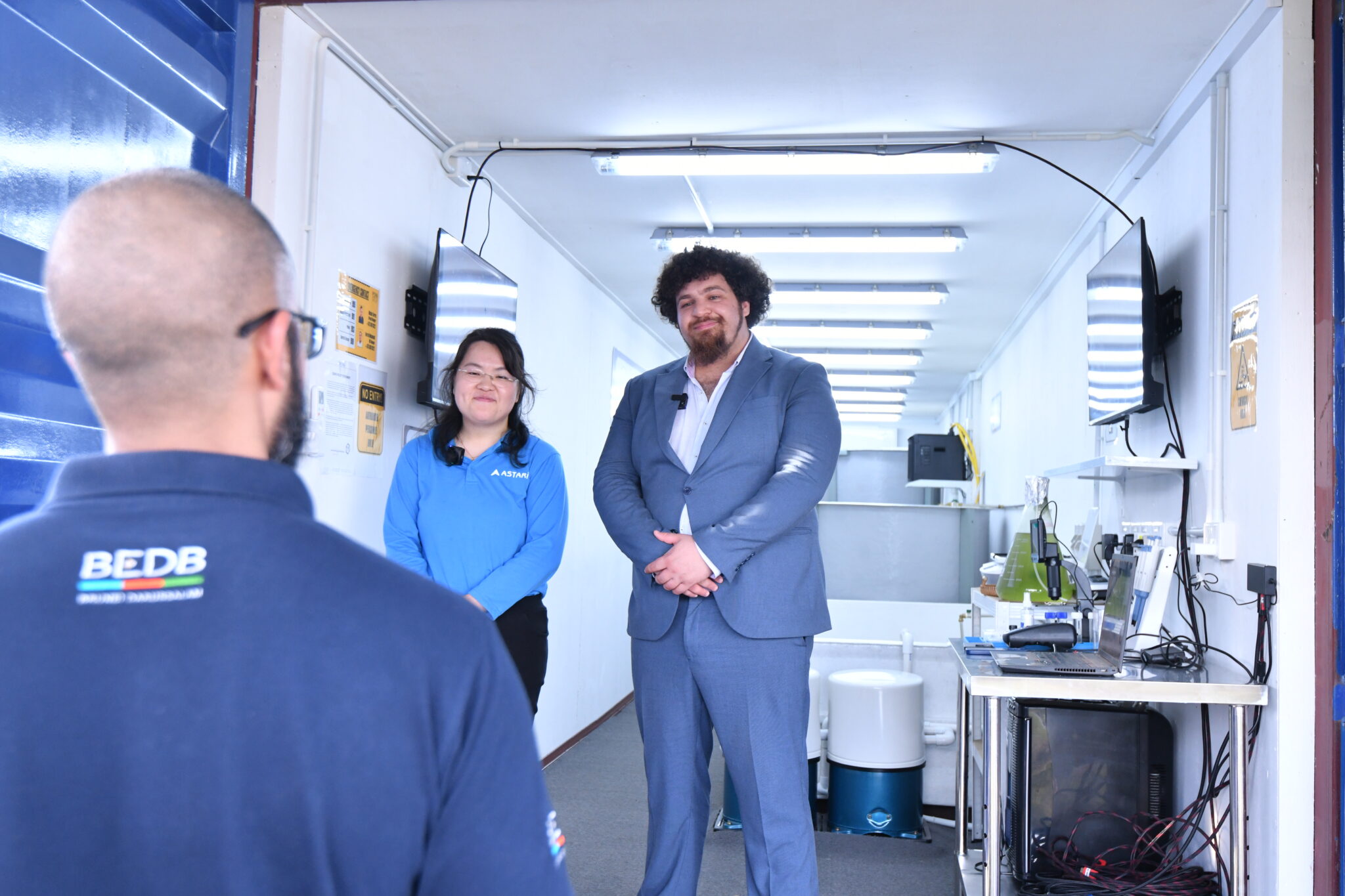
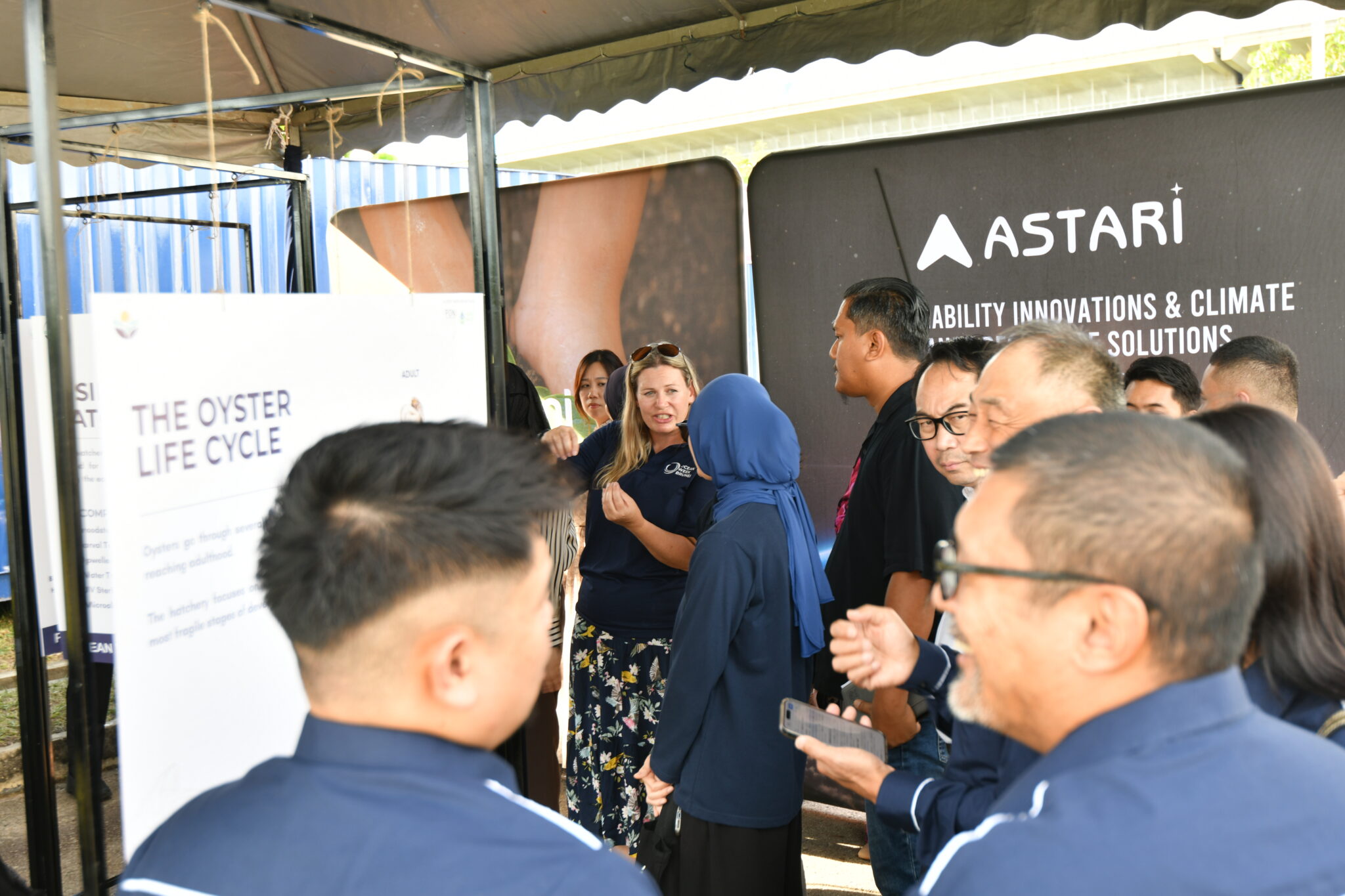
Brunei’s first smart oyster hatchery was soft-launched on Wednesday, 24 June 2026, marking a major step forward in the development of sustainable aquaculture, marine biotechnology, river restoration and future blue economy industries in Brunei.
The event was graced by Guest of Honour, Yang Mulia Puan Hajah Tutiaty binti Haji Abdul Wahab, Deputy Minister of Economy, Trade and Industry, and attended by over 60 participants, including project partners, invited stakeholders, technical teams, government representatives, presearchers and community partners.
The smart oyster hatchery is being launched through Sunda Futures, a joint venture between Poni Group, its innovation hub ASTARI, and Clean Valley CIC, a Canadian environmental biotechnology and sustainable aquaculture solutions company. The hatchery uses Clean Valley CIC’s Neptune Hatchery technology, a smart, modular and containerised system already developed to make oyster hatchery production more accessible, scalable and affordable.
In his remarks, Mohd Tahsin Wong Abdullah, CEO of Poni Group and ASTARI, said the hatchery represents another side of Poni Group’s work beyond Ocean Week Brunei and Poni Foundation’s conservation and community programmes. Through Poni Marine, the group supports marine industries and aquaculture with engineering and construction services, while ASTARI explores how technology, AI and international partnerships can help develop new opportunities for Brunei.
He shared that the project began three years ago through conversations around aquaculture innovation. One of those conversations connected Poni Group with Nick from Clean Valley CIC in Canada, where Tahsin had spent over eight years studying and working. Through Her Excellency Ambra, Ambassador of the Mission of Canada to ASEAN, the teams were introduced and began discussing how blue solutions developed in Canada could support Brunei and the wider ASEAN market.
The initial discussions focused on algae biofilter technology before expanding into oyster hatchery systems and sustainable aquaculture. During Ocean Week Brunei 2025, Clean Valley CIC joined the Ocean Sustainability Conference, signed an MoU with Poni Group, and was keynote speaker at the Future Ocean Changemakers Youth Forum. Around the same period, Poni Group also met Alice, who was conducting her Masters research on oysters in Brunei in UBD, leading to a wider question: could oysters become a future industry for Brunei?
From there, the team began exploring local oyster potential in Muara, Jerudong and Kg Ayer, and later travelled to Australia to visit oyster farms and hatcheries, and to China to meet research partners and learn from larger hatchery systems. These visits helped shape the idea that Brunei could develop a hatchery system that is useful locally, but also valuable to the region.
The soft-launch introduced the technology and business direction behind the hatchery, ahead of its official facility opening planned for the end of 2026. The hatchery is expected to support oyster spat production, oyster nurseries, future oyster farming, river remediation, marine biotechnology and wider aquaculture opportunities in Brunei and the region.
Clean Valley CIC develops nature-inspired aquaculture technologies focused on sustainable seafood production, water treatment, environmental monitoring and circular economy solutions. The company already has a presence in Portugal, Brunei, Mexico, the United Kingdom, the United States and Canada, reflecting growing global interest in sustainable aquaculture and modular hatchery solutions.
The Neptune Hatchery system represents a different approach to traditional hatchery development. Conventional oyster hatcheries can cost between USD4 million to USD6 million to set up and may require three to 20 acres of land, depending on scale and design. Through modular design, smart sensors, IoT systems, AI-assisted monitoring and automation, the Brunei hatchery model reduces the footprint into two 40-foot container units, making the system more practical for small countries, island states, aquaculture farms and coastal communities.
This makes the hatchery not only a local aquaculture facility, but also a potential export product for Brunei. Under Sunda Futures, the current oyster hatchery export plan has already attracted interest from Australia and the ASEAN region. Poni Group, ASTARI and Clean Valley CIC are exploring fabrication and export of similar hatchery systems by next year, as well as opportunities to operate or deploy these hatcheries in other ASEAN countries.
Mohd Tahsin said the hatchery represents capability building, technology transfer, exports and international collaboration. He added that for ASTARI, the goal is not simply to import technology, but to understand it, improve it, and eventually develop Brunei’s own solutions and intellectual property.
The hatchery will initially focus on oyster spat production. Oyster spat refers to young oysters that can be grown in farms, nurseries or restoration systems. Once operational, the hatchery can help reduce dependence on imported spat, support local oyster industry development and provide the foundation for Brunei’s first commercial mangrove oyster product.
Beyond oysters, the hatchery technology can potentially be adapted for other marine species and ecosystems, including lobsters, seaweed, clams, mussels and seagrass-related restoration work. This gives the facility a wider role as a platform for aquaculture innovation, marine biotechnology and future coastal restoration projects.
A key part of Clean Valley CIC’s wider technology approach is its bio-algae filter system, which uses algae and natural biological processes to support aquaculture water treatment. The algae can help improve water quality, recycle nutrients and support more sustainable aquaculture operations. This approach reflects the wider idea behind Sunda Futures: using nature-based technology to solve real industry and environmental problems.
Sunda Futures is being developed as a blue economy venture that can support a range of future products and services, including oyster hatcheries for export, oyster spat production, oyster farms, oyster remediation projects, oyster nurseries, oyster pearl development, bio-algae filters, tidal breakwater concepts and future offset credits linked to restoration and environmental impact. The longer-term product pipeline also includes oyster restaurants, oyster tours, oyster ecosystem experiences, oyster farm collectives, oyster-based peptides for nutraceuticals, purified oyster shell calcium research, oyster shell products, carbon neutral concrete applications, marine biotechnology and future blue accelerator programmes.
Poni Group said the hatchery is important because it can help build an entire oyster ecosystem in Brunei. This includes hatchery operators, farmers, technicians, researchers, restaurants, tour operators, product developers, community workers and export opportunities. Instead of looking at oysters only as seafood, the project looks at oysters as part of a wider system that can support water quality, jobs, exports, tourism, research and future industries.
The hatchery will also support the Warisan Oyster Project, which is part of the River Kitani initiative. The Warisan Oyster Project is a 10-year programme focused on river restoration, community livelihoods, blue economy development, environmental monitoring and future offset credits. The project aims to use oysters, reef structures, mangroves and monitoring systems to support river health and create long-term community opportunities, beginning with Kg Bolkiah and surrounding river communities.
Through the hatchery, oyster larvae and spat can be produced for deployment in oyster reef balls, nurseries, farms and remediation sites. In the Warisan Oyster Project, these oysters are expected to help filter water, improve river conditions, support fish habitats and create future opportunities for local residents through shell collection, monitoring, deployment work, eco-tourism, aquaculture and community-based businesses.
The smart hatchery also supports Brunei’s wider blue economy direction by connecting technology, aquaculture, conservation, community livelihoods and export potential. It shows how a small country like Brunei can test practical systems that may later be scaled across ASEAN and other coastal markets.
The soft-launch of Brunei’s first smart oyster hatchery marks the beginning of a larger journey. With the official launch and facility opening planned for the end of 2026, the project aims to move from demonstration into production, testing, training and future commercial expansion.
The long-term vision is to position Brunei not only as a user of sustainable aquaculture technology, but as a developer, operator and exporter of smart blue economy solutions for the region.