

BANDAR SERI BEGAWAN, Brunei Darussalam – Two agreements signed in Nanning open pathways for marine biotechnology, mangrove research, technology transfer and regional collaboration.
ASTARI, Poni Group’s applied research and innovation hub, returned from the 23rd China–ASEAN Expo (CAEXPO) in Nanning, Guangxi, with two new research partnerships and a broader pipeline of technology and business opportunities that could support the development of Brunei’s blue economy.
Its participation in the ASEAN High-Tech Gallery brought ASTARI into contact with research institutions, technology companies, government representatives, ASEAN businesses, manufacturers, students and members of the public. Beyond showcasing its work, the engagement created opportunities to explore how international science, technology and research capabilities could be adapted to address practical industry and environmental needs in Brunei.
The focus following CAEXPO is now on turning these connections into structured research, technology demonstrations, skills development and viable opportunities for businesses and communities.
Two Partnerships, Distinct Research Pathways
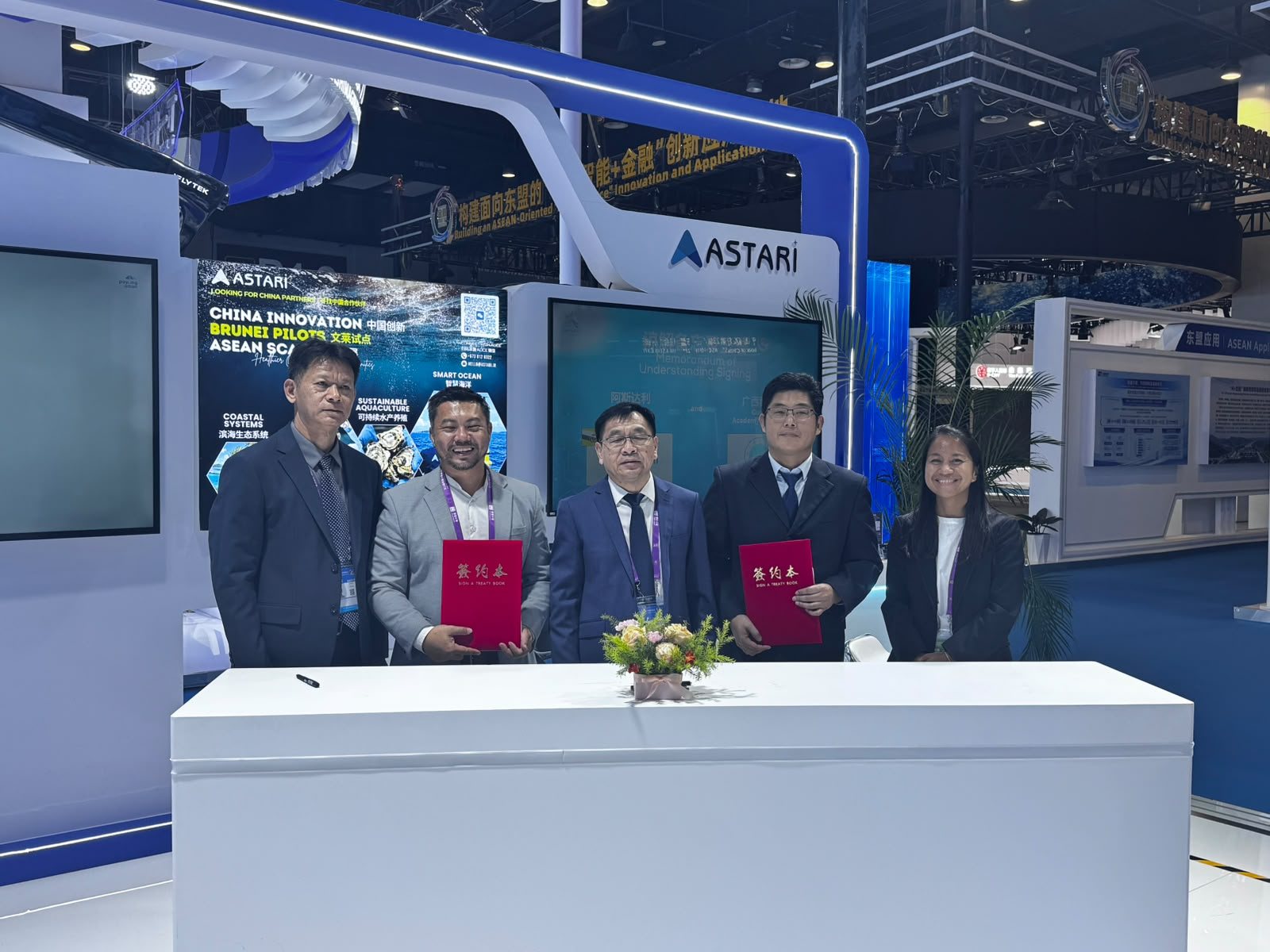
On 17 September 2026, ASTARI signed two agreements in Nanning: a Commissioned R&D and Technology Development Agreement with Fujian Ocean Innovation Center and a five-year Memorandum of Understanding with Guangxi Academy of Sciences.
Founder and Chief Executive Officer of Poni Group, Mohd Tahsin Wong Abdullah, signed both agreements on behalf of ASTARI. Professor ZHANG Miansong signed for Fujian Ocean Innovation Center, while Vice President WU Jun signed for Guangxi Academy of Sciences.
The Fujian ceremony was witnessed by Yang Mulia Awang Mohammad Harris bin Brigadier General (Retired) Dato Paduka Haji Ibrahim, Permanent Secretary (Industry) at the Ministry of Economy, Trade and Industry (METI).
The Guangxi ceremony was witnessed by Academy President Li Dianpeng.
While the two agreements cover different areas, both are aligned with ASTARI’s broader objective of connecting international research and technology with local opportunities in Brunei.
Creating More Value from Aquaculture
The agreement with Fujian Ocean Innovation Center commissions the Brunei Circular Marine Biotechnology Technical Feasibility Study, focused on exploring how aquaculture by-products generated in Brunei could potentially be converted into higher-value applications.
The initial research will examine shrimp shells and tilapia skin from Brunei aquaculture operators, assessing their suitability as raw materials for potential nutrition and health-related ingredients.
Among the priority research pathways are collagen and marine calcium. The study is expected to include raw-material analysis, processing trials and preliminary formulation work, with a target of developing at least two laboratory-scale proof-of-concept prototypes.
The findings will also be used to identify potential technical pathways towards future industrialisation, including recommendations on processing, quality considerations and areas requiring further research and validation.
The study is planned to take approximately eight months from formal commencement, subject to the necessary approvals and sample-delivery arrangements.
Professor Zhang Wei, Chief Scientist and Deputy Director of Fujian Ocean Innovation Center, will serve as ASTARI’s Senior Scientific Officer for the project, supporting scientific direction and knowledge transfer throughout the study.
For Brunei, the research provides an opportunity to investigate whether materials currently treated as aquaculture waste or low-value by-products can contribute to new value chains.
Beyond the potential products themselves, the project is also intended to strengthen local capabilities in laboratory testing, processing, quality assurance and product development. These capabilities can be important for developing a broader marine biotechnology ecosystem in Brunei.
At this stage, the work is focused on technical feasibility and proof of concept. Any future manufacturing, commercialisation or sale of resulting products would depend on successful research outcomes, further validation, commercial arrangements and the relevant regulatory approvals.
Strengthening Mangrove and Coastal Research
The five-year Memorandum of Understanding with Guangxi Academy of Sciences provides a broader framework for collaboration through joint research, technical exchange, training and demonstration projects.
Potential areas of cooperation include mangrove conservation and restoration, biodiversity monitoring, blue carbon, coastal resilience and sustainable aquaculture, drawing on expertise of the Guangxi Mangrove Research Center from the Guangxi Academy of Sciences.
Potential early areas of work include mangrove health assessments, scientific support for Carbon AKAR and research into restoration methods suited to Brunei’s coastal conditions.
Technology could also play an important role in these activities. Where appropriate, tools such as remote sensing, drones, environmental sensors and AI-assisted analysis could support field monitoring, data collection and ecological assessment.
The partners may also explore the potential of useful natural compounds associated with mangrove biological resources. Any such work would begin with scientific feasibility and appropriate safeguards for sustainable use, with emphasis on understanding the resource before considering possible applications.
The memorandum establishes a framework rather than committing the parties to a fixed programme of projects. Specific activities will therefore require agreed workplans, funding arrangements, technical scopes and the necessary approvals before implementation.
New Technology and Regional Business Opportunities
ASTARI’s engagement at the ASEAN High-Tech Gallery extended beyond marine science and biotechnology.
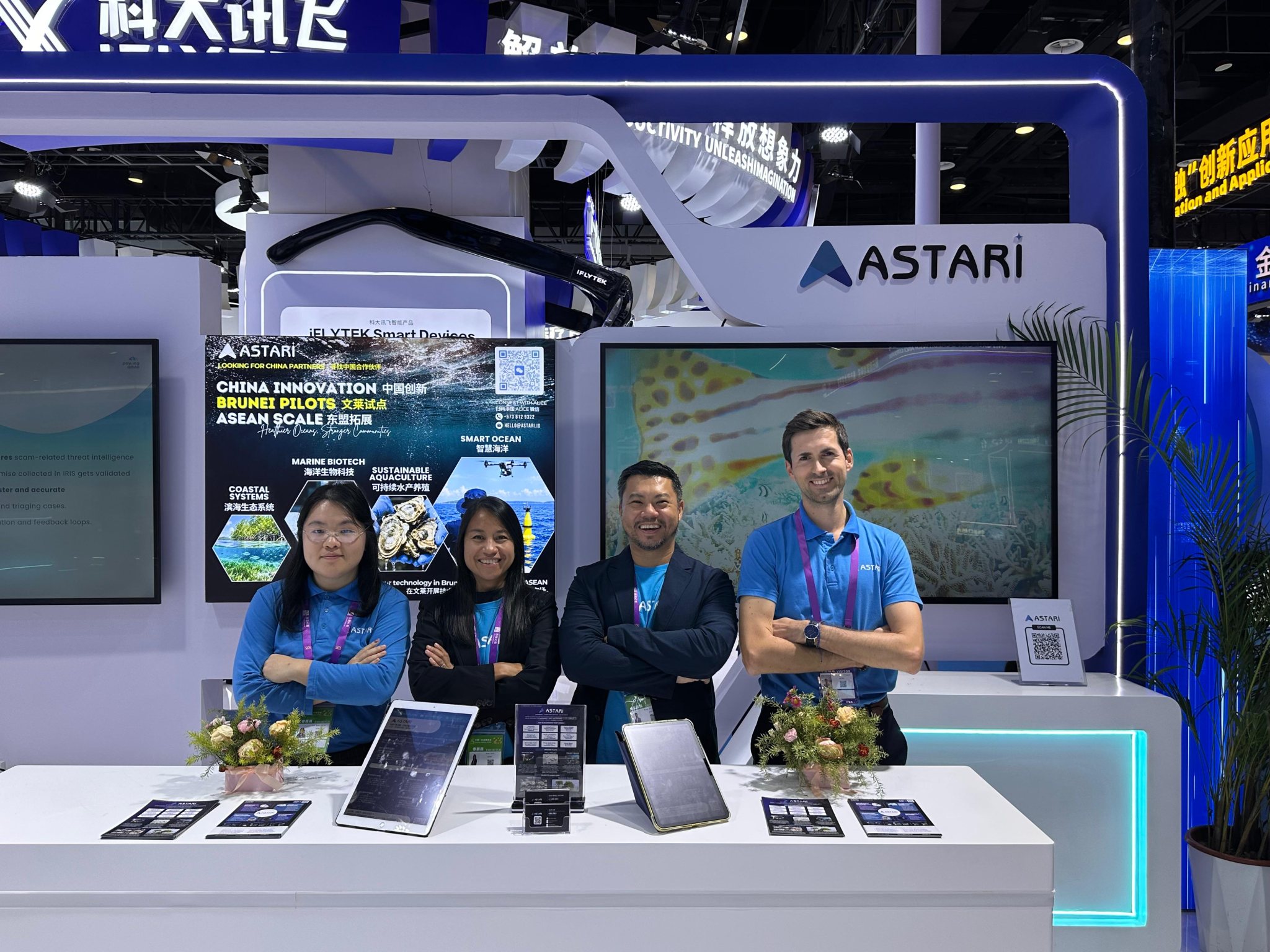
During the expo, ASTARI personnel engaged with Chinese government representatives, state-owned enterprises, universities, research institutes, technology manufacturers, ASEAN businesses, media organisations and students including general visitors.
A recurring area of interest was Brunei’s potential role as a location for technology testing, joint research and the development of solutions intended for tropical and ASEAN markets.
Discussions explored potential collaboration on digitalisation projects in Brunei, including possible joint bids, local technology pilots and the potential integration of Bruneian Malay into its ASEAN language AI model.
Engagement also opened discussions around the possible joint development of a blue economy assessment framework tailored to Brunei, with potential for wider ASEAN application.
Meanwhile, equipment suppliers presented opportunities in areas such as robotics education, a potential laboratory involving Universiti Brunei Darussalam (UBD) or Universiti Teknologi Brunei (UTB), and search-and-rescue applications.
Other research and technology discussions covered aquaculture, alternatives to antibiotics in shrimp farming, marine nutraceuticals, ocean monitoring and disaster prediction.
Several organisations encountered at the expo also have an ASEAN expansion mandate, with some indicating potential access to research or project funding. ASTARI has begun discussions around possible visits to Brunei in 2027.
These opportunities remain under development. Further discussions will be required to determine the appropriate scope, local partners, funding mechanisms and implementation arrangements for each initiative.
Positioning Brunei as a Development and Demonstration Partner
A key focus for ASTARI is to help bring suitable international technologies into Brunei for local testing, adaptation and demonstration, before exploring opportunities for wider deployment across ASEAN.
This approach is intended to move beyond technology transfer alone. Where successful, it could create opportunities for research partnerships, commercial contracts, technology development, investment and local skills transfer, while allowing Bruneian institutions and businesses to participate directly in implementation.
ASTARI also identified potential opportunities involving ESG monitoring and natural-disaster predictive modelling, including capabilities offered through its Canadian and Indonesian technology partners.
At the same time, relationships developed with manufacturers, accreditation bodies and distributors could support future routes into China and ASEAN markets for technologies and products developed through successful research and commercialisation efforts.
Engagement with Malaysian and Indonesian companies also opened potential opportunities for reciprocal programmes, research collaboration and business partnerships.
The wider purpose is to strengthen Brunei’s position not only as a market for international technologies, but as a development and demonstration environment where technologies can be tested under local conditions and refined for application across the region.
Reaching Wider Audiences
ASTARI’s participation also generated media engagement, including interactions with People’s Daily, Guangxi TV, the South China Morning Post and Radio Television Brunei.
These engagements provided an opportunity to introduce ASTARI’s work, Brunei’s marine and blue economy opportunities, and the country’s potential role in international research and technology partnerships to a wider audience.
Support from Brunei and Chinese organisers also contributed to the successful agreement signings and ASTARI’s participation in the National Promotion Seminar, where the institute was able to present its vision and areas of interest to a broader audience.
From International Connections to Practical Projects
Following CAEXPO, ASTARI’s immediate priority is to move from discussions and introductions towards defined programmes of work.
For the Fujian partnership, this means progressing the Brunei Circular Marine Biotechnology Technical Feasibility Study, completing the required analysis and processing work, and developing validated laboratory-scale proof-of-concept prototypes that can inform future decisions on commercialisation.
For the Guangxi partnership, ASTARI will work with its partners to develop focused cooperation plans covering selected areas of mangrove, blue carbon, coastal and aquaculture research.
For priority technology leads identified at the expo, the next stage will involve defining potential pilot scopes, identifying appropriate Brunei-based customers and institutional partners, exploring funding opportunities and organising targeted partner visits.
The wider China pipeline also includes potential oyster-seed trials and breeding collaboration, as well as sea-cucumber breeding discussions with the Institute of Marine Medicines at Guangxi University of Chinese Medicine.
Beyond China, ASTARI is also assessing technologies and research opportunities from partners in Canada and the United Kingdom that may be suitable for local trials.
The purpose of this broader pipeline is not to pursue every opportunity simultaneously, but to identify those with the strongest technical, commercial and strategic fit for Brunei.
Building the Infrastructure to Support Innovation
ASTARI’s ability to turn these opportunities into practical projects will depend not only on international partnerships, but also on the availability of appropriate facilities and local support.
The institute is seeking access to a suitable coastal R&D facility with seawater access and space for aquaculture, marine biotechnology and technology trials.
Such infrastructure would provide a practical environment for controlled testing, demonstration and collaborative research, while supporting local training and the participation of universities, businesses and other institutions.
Further support areas include connections with investors, relevant government agencies, UBD and UTB, as well as assistance in exploring suitable ASEAN and ASEAN–Australia research and innovation funding opportunities.
ASTARI is also looking to facilitate targeted business matching through visiting delegations, partner visits and relevant overseas missions and exhibitions.
With suitable facilities and focused follow-up, Brunei could develop into a base where international technologies are tested under tropical conditions, adapted with local expertise and progressed towards solutions serving ASEAN markets.
For ASTARI, progress will ultimately be measured through tangible outcomes: research completed, people trained, technologies demonstrated and applications that create lasting value in Brunei.
About ASTARI
ASTARI — Applied Science, Technology & Artificial Intelligence Research Institute — is Poni Group’s applied research and innovation hub.
ASTARI focuses on joint research and development, technology validation and demonstration, talent training and research commercialisation, connecting scientific expertise and emerging technologies with practical industry and environmental needs.
Partnership and media enquiries:
Alice Lee
alice.lee@astari.io
+673 812 9322